
For marketing teams and agencies

You find out on Monday. It happened on Tuesday.

The numbers are there. Nobody watches them continuously, and what you learned last year is written down nowhere. We watch every day, flag what deviates with the reason attached, and change nothing without a person with a name.

Fifteen minutes of work on our side, no commitment. You see straight away which of your clients' buyer questions their brand is missing from, per client.

What sits underneath

No black box. A knowledge layer you can read.

Every piece of advice from the system rests on principles from published research, each with the limit of what it means. Not a model that "sees something in the data", but reasoning you can explain to your client and argue with.

105

principles across seven domains, from tracking to brand building

27

with a citable anchor: Ehrenberg-Bass, IPA Databank, Baymard, Cialdini, Kahneman

12

conflict rules for when two principles disagree

The strongest part is not the list but the limit. Under 60/40 brand and activation it says: a calibration point per category, growth stage, budget and purchase frequency, not a law. Anyone can repeat a promise. A knowledge layer with sources and limits, they cannot.

Every day between the deviation and the noticing, you pay full price for a creative that is spent.

An execution loses its power over days, not all at once. Cost per click rises, click-through drops, and the weekly report sees it once it has lasted a week. The same goes for a measurement that quietly breaks.

Request the free scan

The scan shows in fifteen minutes where a client stands now. Then you decide.

Two things we do not do.

We change nothing in your accounts

There is no write path to Google or Meta in this system, by design. Every proposal becomes a task with a name under it, and a person carries it out or explains why not. No second pair of hands touching your budgets without a conversation.

We are not another dashboard

You already have two. Here you do not have to look: you get a notification when something deviates, with the reason, the proposal and the source, so you can check it.

What you do get.

Creative fatigue before you feel it

Click-through across rolling windows, rising cost per click, declining interaction and time in market. You hear it while you can still act, not in the evaluation.

Fresh data, or it is marked as old

Every connection records when it last succeeded. If a sync breaks, it says stale, not a chart quietly running on last month's numbers.

A memory that stays

What you did in the same week last year, what it cost and what you learned. If the person who knew it leaves, it stays.

What that looks like

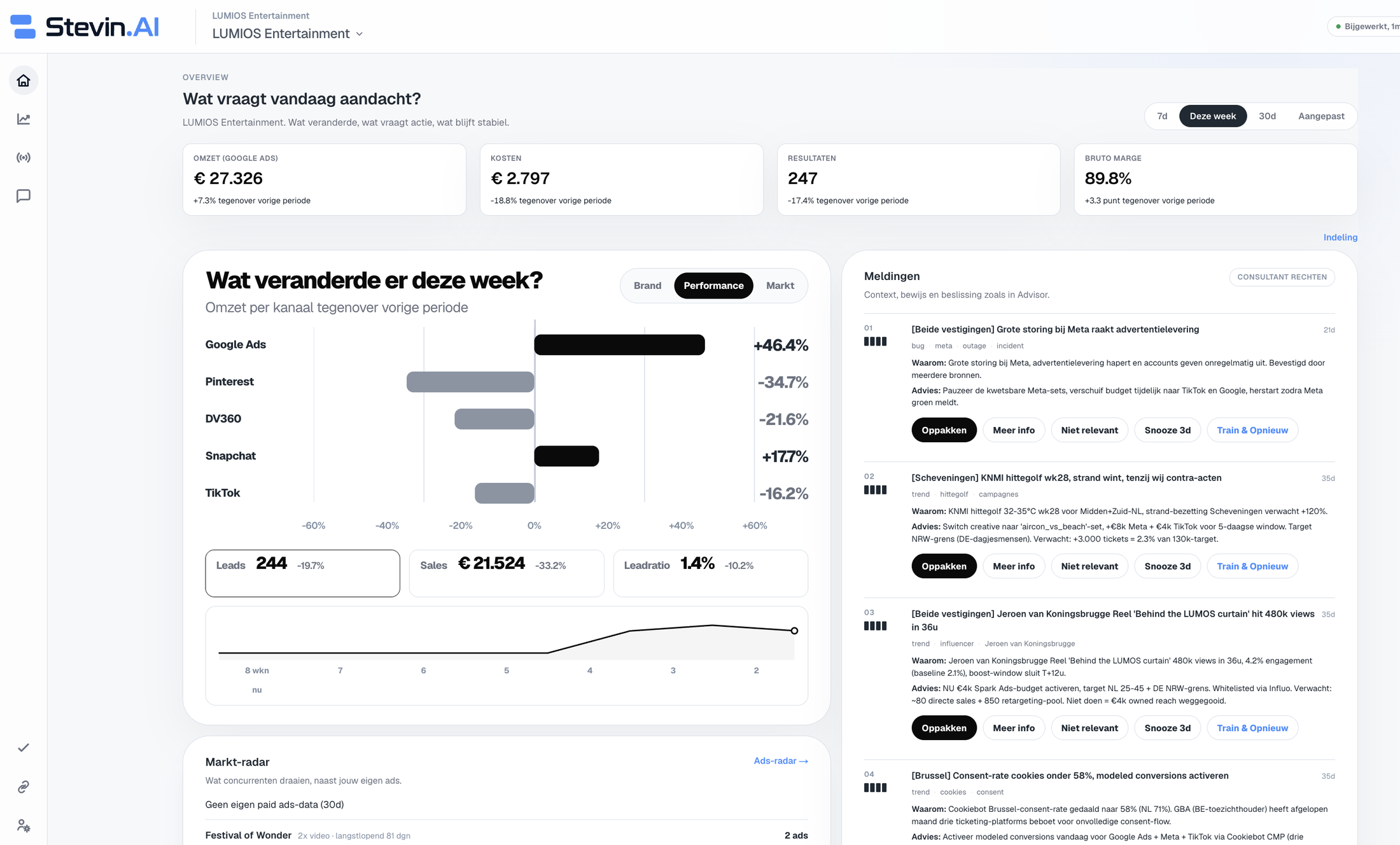
What is going wrong, what is working, and why. On one screen.

Not a report after the fact. Stevin watches what comes in today and what your brand is worth a year from now. Those are two different things, and they rarely sit in the same overview.

The Stevin Desk: alerts with the reason and the advice, numbers per channel and the market radar
01

[Both venues] Major Meta outage is affecting ad delivery

bugmetaoutageincident

Why: Ad delivery is stuttering and accounts are spending erratically. Confirmed by several sources.

Advice: Pause the exposed Meta sets, shift budget to TikTok and Google for now, restart once Meta reports green.

Pick upMore infoNot relevant

From the Stevin Desk. LUMIOS is our demo environment, not client data.

And everything that was tried is still there.

Every campaign, every decision, every result, and what the competition was doing at the time. Including the work that only pays off months later, which is the first thing to drop out of sight. Whoever starts here tomorrow reads up, instead of you explaining it all over again.

A single client memory, the way it sits in the Desk.Drag the nodes around.

Three principles we apply to ourselves too.

As they sit in the system, with their limits. A principle without a limit is a dogma.

Check tracking and conversion configuration before judging anything else.

An event firing at the wrong moment invalidates every diagnosis. The classics: a purchase event on page load, and UTM tags breaking along the way.

Practice principle from the knowledge layer

Does not mean you cannot advertise without perfect measurement. It means you do not read your numbers blindly.

Judge every channel on business outcomes across channels, never on channel-owned metrics.

Email pushes conversions that land elsewhere, and reach channels show up as lift on brand search, not on their own last click.

Practice principle from the knowledge layer

Does not mean opens and clicks are useless. They remain diagnostics; they just do not belong in the steering layer.

Treat platform recommendations as a sales signal: demand evidence before applying them.

The optimisation score is a sales metric, and automatic enhancements change your creative without being asked.

Practice principle from the knowledge layer

Does not mean recommended features never work. With a sound conversion signal underneath they can be perfectly good.

Why we know this.

Built by someone who spent twenty years on the agency side and owned one. The monthly report, the exports, the merging: that is not a detail of the work, it is the bulk of it.

What was rarely included: someone watching continuously, and a place where last year's lessons stayed. That lived in the head of whoever ran the account, and that person changed jobs.

What teams ask us first.

We are an agency ourselves. Is this competition?

No. We take over no accounts and change nothing in yours. We are the layer that watches and remembers every day, so you spend your time on your client instead of on the report. Your client sees your name, not ours.

Which integrations actually exist?

Google Ads, Meta, GA4, Search Console, Tag Manager, Merchant Center, Shopify, WooCommerce, Klaviyo, Mailchimp, TikTok, LinkedIn, Pinterest and YouTube. No others. If something is not on the list, we read the export and say so.

What does it cost?

The scan is free. After that you choose: monitoring only from 399 a month per client, or the full diagnosis. You keep the report, even if you do nothing further with us.

Start with the scan.

Fifteen minutes per client. No account access needed. You see which of their buyers' questions the brand is missing from, and who is there instead.

Fifteen minutes of work on our side, no commitment. You see straight away which of your clients' buyer questions their brand is missing from, per client.