
For museums and culture

People who know you, find you. People who do not, find someone else.

Your growth sits with the visitor who was not thinking of you yet. We measure where you stand on that visitor's questions, and keep your Google Ad Grant within the rules, with a small team and a small budget.

Fifteen minutes of work on our side, no commitment. You see straight away which new-visitor questions your institution is missing from.

Measured on 4 September

We measured a Dutch museum. On questions from people who knew it, it did well. On the rest, it did not.

Twelve questions put to an AI with live search. About the collection, the city, opening hours and tickets. And three questions from someone who does not know the museum yet: what to do with children around this theme, how to prepare for such a visit.

7 of 12

times its own site was a source. A good score.

0 of 3

new-visitor questions named the museum

quiltmuseum.org

and two other foreign sites gave those answers

On the question from a family looking for a day out around your theme, the answer named a museum in London and one in New York. Not you. That group is where your visitor growth has to come from, and there you are invisible while you score fine on your own name.

Every campaign aimed at your own name pays for visitors who were coming anyway.

A small team steers on what it sees: the name, the exhibition, the friends. Nobody sees the question of someone who was not thinking about it yet, so no budget goes there. Meanwhile the Ad Grant runs its risk with nobody watching.

Request the free scan

The scan shows in fifteen minutes which questions you are missing. Then you decide.

Two things we do not do.

We do not connect your ticketing system

No integration with your ticketing platform, donation form or membership records. So we do not count which ad sold which ticket. We put your own export alongside, with a definition underneath, so the number means something.

We do not measure visitors inside the building

No counters, no location data, no QR constructions. Anyone promising to connect online media to footfall without your point of sale is working from assumptions.

What you do get.

The questions of people who do not know you

Where you stand in search results and AI answers on questions without your name in them. A different list from the one you steer on now, and the list new visitors come from. Baseline fixed, measured again in ninety days.

Ad Grants within the rules of Google

Five percent click-through rate per month at account level, two months below means temporary deactivation, no single-word keywords. We manage within that and warn you well before the danger zone.

Season next to your numbers

Holidays, weather and local events decide more here than a creative choice. They sit next to your numbers when you judge whether a campaign worked, not as an excuse afterwards.

What that looks like

What is going wrong, what is working, and why. On one screen.

Not a report after the fact. Stevin watches what comes in today and what your brand is worth a year from now. Those are two different things, and they rarely sit in the same overview.

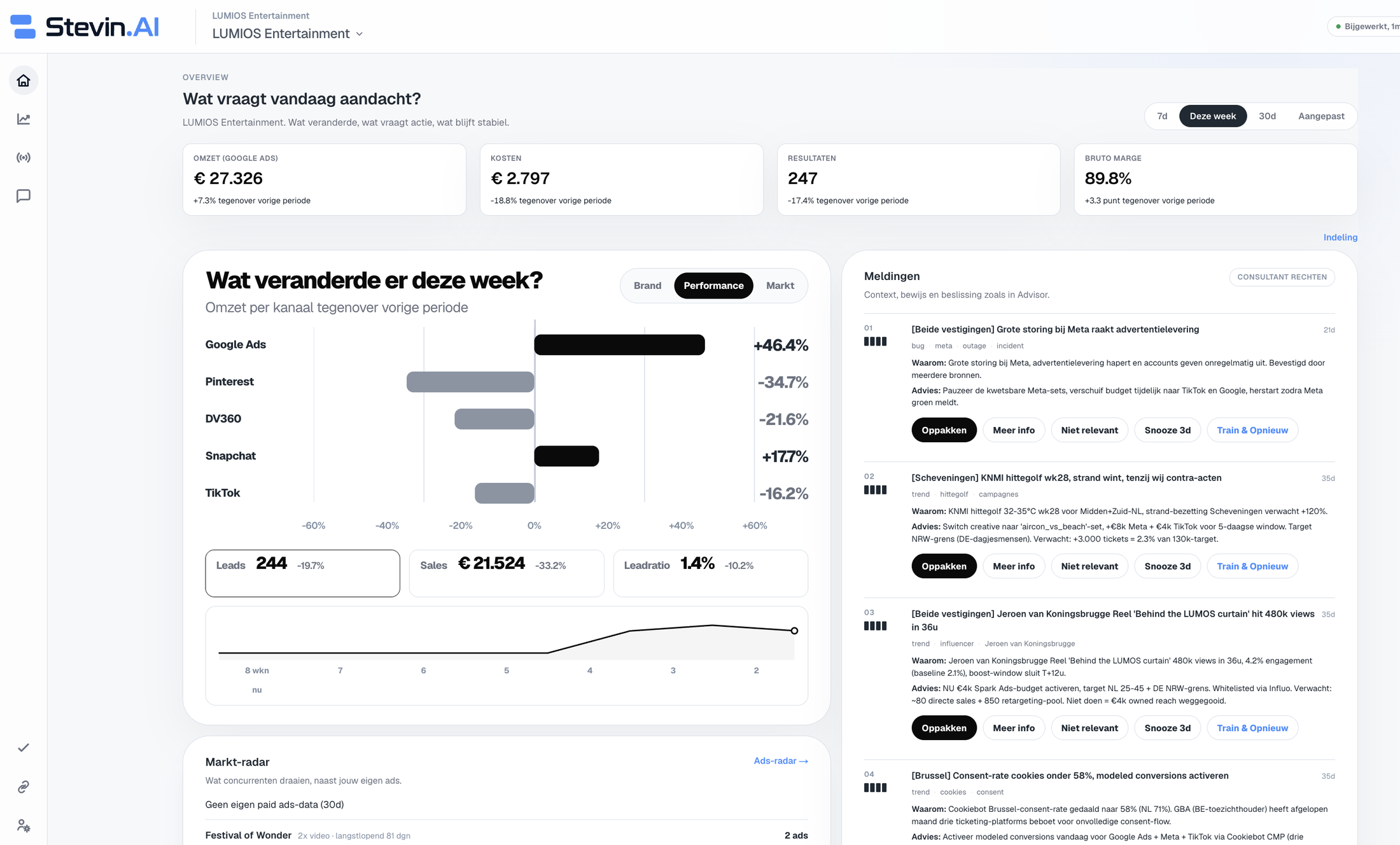
The Stevin Desk: alerts with the reason and the advice, numbers per channel and the market radar
02

[The Hague] Heatwave week 28, the beach wins unless we counter

trendheatwavecampaigns

Why: Heatwave of 32-35°C forecast for week 28, beach occupancy expected up 120%. The Brussels venue is unaffected.

Advice: Switch creative to the indoor set and shift budget for a five-day window, only for the venue it hits.

Pick upMore infoNot relevant

From the Stevin Desk. LUMIOS is our demo environment, not client data.

And everything that was tried is still there.

Every campaign, every decision, every result, and what the competition was doing at the time. Including the work that only pays off months later, which is the first thing to drop out of sight. Whoever starts here tomorrow reads up, instead of you explaining it all over again.

A single client memory, the way it sits in the Desk.Drag the nodes around.

Why the advice holds.

Under every piece of advice sits a knowledge layer of 105 principles from published research. Three of them, as they sit in the system, with their limits.

Reach the whole category buyer: light and occasional visitors deliver a large share of the volume.

Even strong brands draw half their buyers from people who buy once or twice a year. That research comes from the supermarket, but the pattern is the same: growth comes from the day-tripper, not from making your friends even more loyal.

Ehrenberg-Bass

Does not mean targeting is never useful, and membership schemes have a function of their own.

Look for friction before you advise a persuasion campaign.

The real barrier is usually convenience: a ticket flow with too many steps, unclear parking, unclear what is on right now. Making behaviour easier works more often and more cheaply than changing an attitude.

Practice principle from the knowledge layer

Does not mean communication never shifts an attitude. It means you remove the barrier first.

Use social proof with recognisable people and verifiable numbers.

Evidence people can observe themselves beats claimed popularity. A family that resembles the visitor works better than an award or a quote from the trade press.

Keizer et al. 2008

Does not mean it works equally well everywhere. With people judging on content it weighs less.

Why we know this.

Built by someone who spent twenty years on the other side of the invoice, as the founder of an agency, with museums and a concert hall among the clients. The same pattern every time: a small team, many channels, and a ticketing system that keeps labels like "new", "frequent" and "dormant", but nobody who can draw the route from first contact to loyal visitor.

And every time the same discovery in the numbers: the young audience is the largest share of visits, but conversion sits with the over-65s, and the best performing campaign is the retargeting of people who already came. Everything points at the visitor you already know. So this starts with the question of the one you do not know yet, and with an Ad Grant that stays switched on.

What institutions ask us first.

Our Ad Grant was paused once. Can that be repaired?

Yes. Google has a fixed route for it: remove the cause, usually by pausing keywords with many impressions and few clicks, then request reactivation. We do that with you, and make sure it does not happen again.

What if the scan shows everything is fine?

Then we say so. The museum above came out well on its own name, and that is what this page says. A scan that may only deliver bad news is not a measurement.

What does it cost?

The scan is free. After that you choose: monitoring only from 399 a month, or the full diagnosis on your own numbers. You keep the report, even if you do nothing further with us.

Start with the scan.

Fifteen minutes. No access to your accounts needed. You see which new-visitor questions you are missing from, and who is there instead.

Fifteen minutes of work on our side, no commitment. You see straight away which new-visitor questions your institution is missing from.