
For dealer groups

Nationally you are large. On the buying question around the corner you do not exist.

Budget is decided centrally, accountability is per location, and nobody can say which region rides on the name and which one only spends. And the mix differs by city: in Groningen almost one in three searches for a premium brand is the compact saloon and almost one in five a van, in Amsterdam it is a quarter and one in seven, and there people search relatively more for the compact SUV. Both locations get the same campaign. We measure it per catchment area, per model.

Fifteen minutes of work on our side, per location, no commitment. You see straight away which buying questions in your region your group is missing from.

Measured on 4 September

Six buying questions from one region. The national group with locations there did not appear.

Six questions put to an AI with live search, about a region where a national dealer group has several locations. The way a buyer asks: which dealer here has new cars with leasing, where do I buy a reliable used car with warranty, who offers maintenance packages.

0 of 6

times the group was named

0 of 6

times a site of the group was a source

local dealers

from the same town gave nearly all the answers

Independent dealers without your buying power, stock or brand contracts were there. National name recognition does not translate by itself into the answer a buyer gets in your area. Six questions is a sample, not a study. But six zeros is no longer a coincidence.

A national average hides the location burning money and the location earning it.

The location with the best address appears to have the best marketing. The location in a difficult area gets blamed for what the area is doing. As long as you report per country, you pay for both without knowing which is which.

Request the free scan

The scan shows per location where you stand now. Then you decide.

Two things we do not do.

We do not connect your DMS or your stock

No integration with your dealer management system, no stock feed. So we cannot see whether an ad is still running on a sold car. If someone promises that: ask which integration exactly, and since when it has been running.

We do not connect used-car portals

What you do on the well-known used-car sites stays in their own environment. We will not pretend to merge it. That saves a conversation about numbers that were never going to add up.

What you do get.

Per location and per model, not per country

Search demand, visibility and advertising pressure per catchment area, split by model. Where the SUV sells and where the estate does, where you ride on the name and where you pay without anything moving. A conversation you cannot have with a national average.

One definition across all brands

Every brand with its own agency usually means every brand with its own definition of a lead. We fix one, with the reason, so you can put brands side by side.

Who advertises in your area

The ad registers of Google and Meta are public. Which dealers and brands advertise in your region and with what, continuously. This works before you are a client.

What that looks like

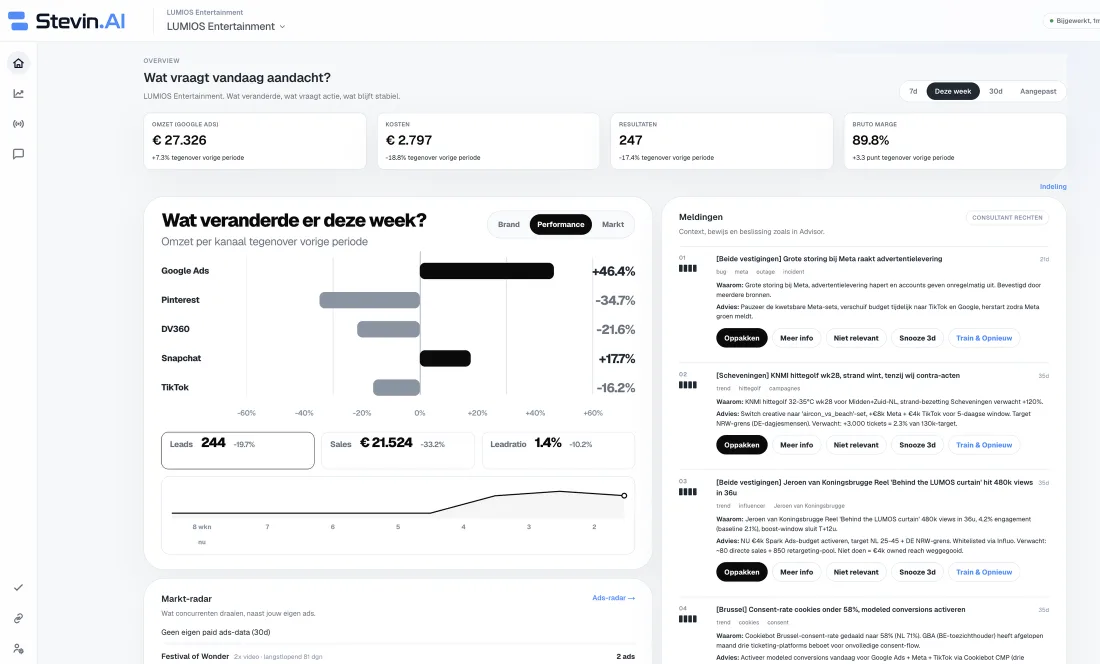
What is going wrong, what is working, and why. On one screen.

Not a report after the fact. Stevin watches what comes in today and what your brand is worth a year from now. Those are two different things, and they rarely sit in the same overview.

The Stevin Desk: alerts with the reason and the advice, numbers per channel and the market radar
07

[South region] Demand is rising where the budget is not

search demandregionbudget

Why: Search volume for your main category has been rising in two regions for three weeks, while the budget is spread evenly across the country. At the stores there you are below your usual impression share, so you are missing demand that exists right now.

Advice: Shift budget to the region where demand is moving, start with one store so you can measure it against the rest, and record what you did and why.

Pick upMore infoNot relevant

From the Stevin Desk. LUMIOS is our demo environment, not client data.

And everything that was tried is still there.

Every campaign, every decision, every result, and what the competition was doing at the time. Including the work that only pays off months later, which is the first thing to drop out of sight. Whoever starts here tomorrow reads up, instead of you explaining it all over again.

A single client memory, the way it sits in the Desk.Drag the nodes around.

Why the advice holds.

Under every piece of advice sits a knowledge layer of 105 principles from published research. Three of them hit this sector squarely, because nobody buys a car today and measurement often pretends otherwise.

Feed bidding algorithms only completed, qualified conversions.

The thank-you page or the conversation that happened, never the button click. Algorithms look for more of whatever you call success, so a polluted signal trains the wrong buyer towards your showroom.

Practice principle from the knowledge layer

Does not mean clicks cannot be recorded. They move to the measurement layer, not the steering layer.

Judge results only after a full conversion cycle.

Costs are complete immediately, conversions trickle in afterwards. With a long consideration, a short window makes your cost per customer look artificially doubled, and anyone correcting then is steering on noise.

Practice principle from the knowledge layer

Does not mean recent numbers are worthless. The cost side you can judge straight away.

Look for friction before advising a persuasion campaign.

A test-drive form with too many fields, no price on the used car, no answer within a day. Making behaviour easier works more often and more cheaply than changing attitudes.

Practice principle from the knowledge layer

Does not mean communication never shifts an attitude. It means you remove the barrier first.

Why we know this.

Built by someone who spent twenty years on the other side of the invoice, as the founder of an agency, running the dealer campaigns for a car brand in the Netherlands and Belgium. Ninety dealers, ninety campaigns, each with its own message in its own area, and per dealer its own report and a budget split on inhabitants and reach per postcode.

It worked, and it taught one thing: the importer's budget was national, demand was local, and the only way to have an honest conversation about one location was to measure per catchment area. So this starts there, and with a definition of a lead that is the same across all brands and all agencies.

What dealer groups ask us first.

Every brand has its own agency. How does this fit in between?

As an independent layer above them. We change nothing in your agencies' accounts; we fix one definition and measure every brand the same way. Your agencies keep their work, you get a picture that holds across all brands.

What if the scan shows everything is fine?

Then we say so, per location. A museum we measured this week came out mostly as good news, and that is what its page says. A scan that may only deliver bad news is not a measurement.

What does it cost?

The scan is free. After that you choose: monitoring only from 399 a month, or the full diagnosis on your own numbers. You keep the report, even if you do nothing further with us.

Start with the scan.

Fifteen minutes per location. No access to your accounts needed. You see which buying questions in your region you are missing from, and who is there instead.

Fifteen minutes of work on our side, per location, no commitment. You see straight away which buying questions in your region your group is missing from.