
For events and touring shows

The date does not move. Sales do.

A tour has an on-sale, a premiere and last days, and ten weeks in between where sales say something every day. We read that every day, per city, and say what has to happen now instead of what happened last week.

Fifteen minutes of work on our side, no commitment. You see straight away which buying questions around your show someone else is answering.

What comes back in every show plan

Four numbers that decide every tour, and rarely sit side by side.

From ten years of media plans for tours, ice shows and circus productions in the Netherlands and Belgium. Not theory: the patterns that came back in the sales data of every city.

60 km

is the radius most of your audience comes from, city by city

40 days

before the first show, sales pick up. Until then you buy awareness, after that urgency

2 to 3

tickets per order, usually bought by a mother between 25 and 44

And the fourth number: at on-sale you want part of the house sold already, because an empty first week is the most expensive thing you can buy. Every city has those four numbers, and almost never do they sit in a system next to the media plan. Then you steer on the gut of the promoter, who is usually right, until the one time he is not.

A tour runs the same media plan every week, while the buyer needs something different every week.

Before on-sale you buy awareness, around the premiere the city talks, in the last days you buy urgency. A flat media plan spends too much in week two on people who decide in week eight, and has too little left in week nine for the people who want to buy now.

Request the free scan

The scan shows in fifteen minutes who sits on the buying questions around your show. Then you decide.

Two things we do not do.

We do not connect your ticketing

No integration with your ticketing platform or sales system. We see sales the way you give them to us: an export, a daily number per city. That is enough to steer on, and more honest than pretending we look into your till.

We are not a media agency with a buying margin

We buy no media and earn nothing on your spend. Your agency or promoter keeps doing that. We are the layer that watches every day, records what worked, and starts the next city with it.

What you do get.

Per city, per phase, per day

Sales, search demand and advertising pressure per city side by side, in the phase that city is in. On-sale in Brussels is not the same as last days in Antwerp, and the plan should know that.

A memory that outlives the tour

What the previous city did, what the previous show did in this city, and what you learned. The best audience for a show is whoever saw the last one, and nobody remembers that once the agency or promoter changes.

Who advertises around your show

The ad registers of Google and Meta are public. Which shows, parks and days out advertise in your city in your weeks, and with what. This works before you are a client.

What that looks like

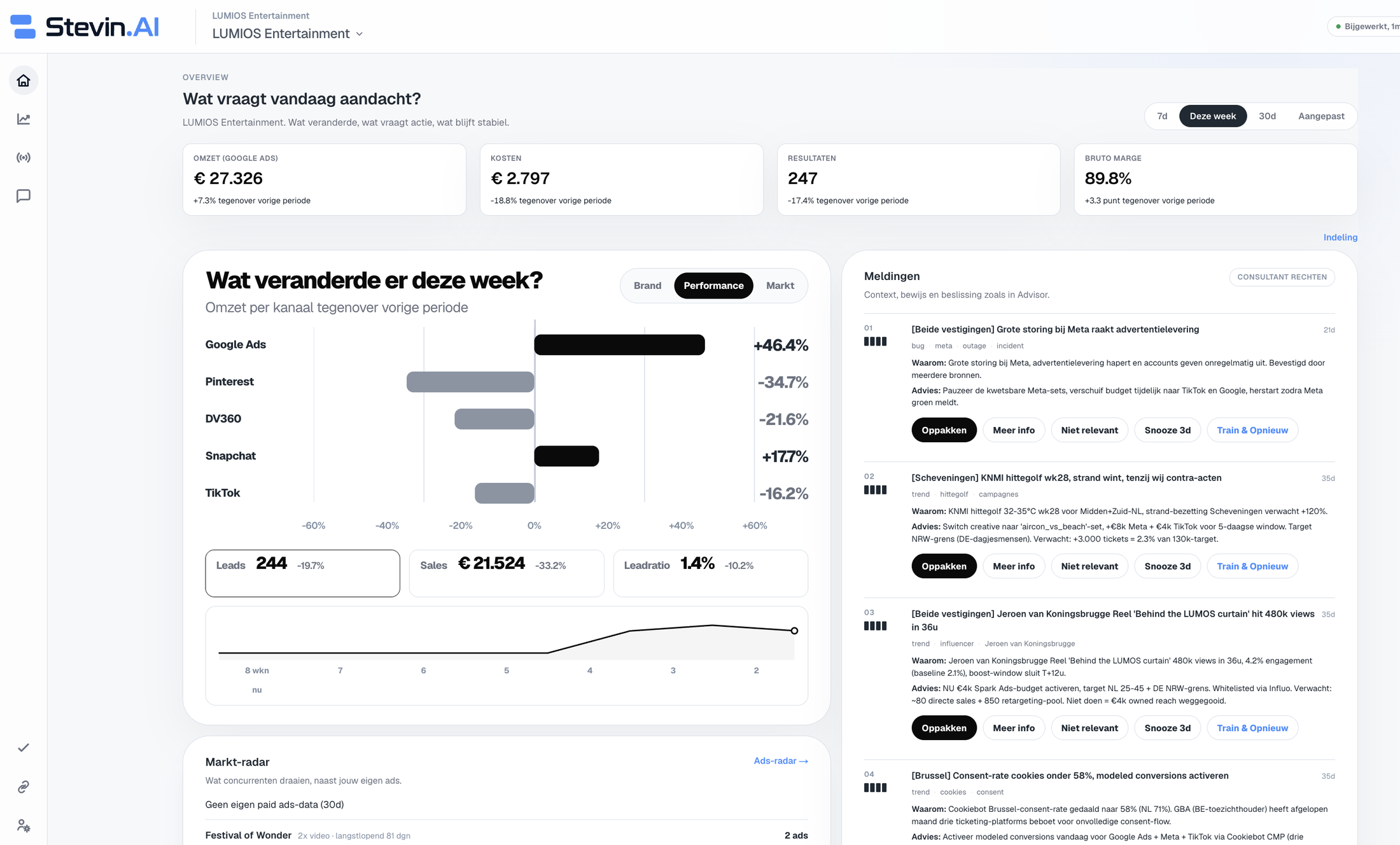
What is going wrong, what is working, and why. On one screen.

Not a report after the fact. Stevin watches what comes in today and what your brand is worth a year from now. Those are two different things, and they rarely sit in the same overview.

The Stevin Desk: alerts with the reason and the advice, numbers per channel and the market radar
04

[Both venues] Reel hits 480k views in 36 hours, boost window closes in 12

trendinfluencertiming

Why: 480k views in 36 hours at 4.2 percent engagement, against a 2.1 percent baseline. The boost window closes at T+12h.

Advice: Put budget behind this creative now and target NL 25-45 plus the German border region. Doing nothing means the reach evaporates.

Pick upMore infoNot relevant

From the Stevin Desk. LUMIOS is our demo environment, not client data.

And everything that was tried is still there.

Every campaign, every decision, every result, and what the competition was doing at the time. Including the work that only pays off months later, which is the first thing to drop out of sight. Whoever starts here tomorrow reads up, instead of you explaining it all over again.

A single client memory, the way it sits in the Desk.Drag the nodes around.

Why the advice holds.

Under every piece of advice sits a knowledge layer of 105 principles from published research. Three of them are about exactly this trade: a deadline, a broad audience and a buyer who decides late.

Reach the whole category buyer: most volume comes from people who rarely go.

Even strong brands draw half their buyers from people who buy once or twice a year. For a show: the family that does one big thing a year, not the fan who sees everything.

Ehrenberg-Bass

Does not mean your own database is worthless. Whoever saw the last show is your best first week, just not your whole house.

Only real, temporary scarcity, as a visible act.

Last days, last rows, a date that does not move: that is real scarcity and it works. Artificial urgency damages trust and touches consumer law.

Cialdini

Does not mean you may shout "almost sold out" every week. A tour does not need that luxury; the date is the scarcity.

Judge results only after a full conversion cycle.

Costs are complete immediately, tickets trickle in. Anyone correcting in week two on week two sales is steering on noise: that buyer decides in six weeks.

Practice principle from the knowledge layer

Does not mean you wait for the premiere. The cost side and search demand you see straight away, and that is what you steer on.

Why we know this.

Built by someone who spent twenty years on the other side of the invoice, doing the online media for ice shows and international circus productions in the Netherlands and Belgium. Two cities back to back, an on-sale in March, a premiere in summer, last days in autumn, and a promoter who looked at the sales number first thing every morning.

What was always missing: those sales numbers sat in one system and the media plan in another, and what the previous city had taught sat in the head of whoever had done that city. So this starts with measuring per city, steering per phase and recording what you tried, so the next tour does not start from zero.

What promoters ask us first.

Our media agency already does the buying. What does this add?

Nothing to the buying, everything to the steering. We buy nothing and earn nothing on your spend. We watch every day per city and per phase, record what worked, and give your agency a reason to shift before the week is over.

The licensor controls the creative and runs social itself. Does this still fit?

Yes, that is the normal situation with big titles. We change nothing in accounts and make no creative. We read what sales and search demand do per city and say where the budget should sit now, within what the licensor allows.

What does it cost?

The scan is free. After that you choose: monitoring only from 399 a month, or the full diagnosis on your own numbers. You keep the report, even if you do nothing further with us.

Start with the scan.

Fifteen minutes. No access to your accounts needed. You see who sits on the buying questions around your show now, per city.

Fifteen minutes of work on our side, no commitment. You see straight away which buying questions around your show someone else is answering.