

The name Stevin
An idea from Belgium, built in Breda.
The first idea came from my own agency in Belgium. We kept meeting clients where three agencies in a row had worked on the measurement, each adding a tag of their own. What was left was double-counted traffic in GA4 and nobody who could still say which number was right. That is where this started.
I was not looking for a new system. Everything was already there: campaign data, CRM, calendar, quotes, project information. What was missing was a layer on top that tied it together and spoke up in time. The right information nearly always reached the right person too late.
What started as an internal solution became the foundation of Stevin. The platform was further developed from Breda into what it is now: the layer that watches your marketing every day and remembers what happened.
Named after Simon Stevin
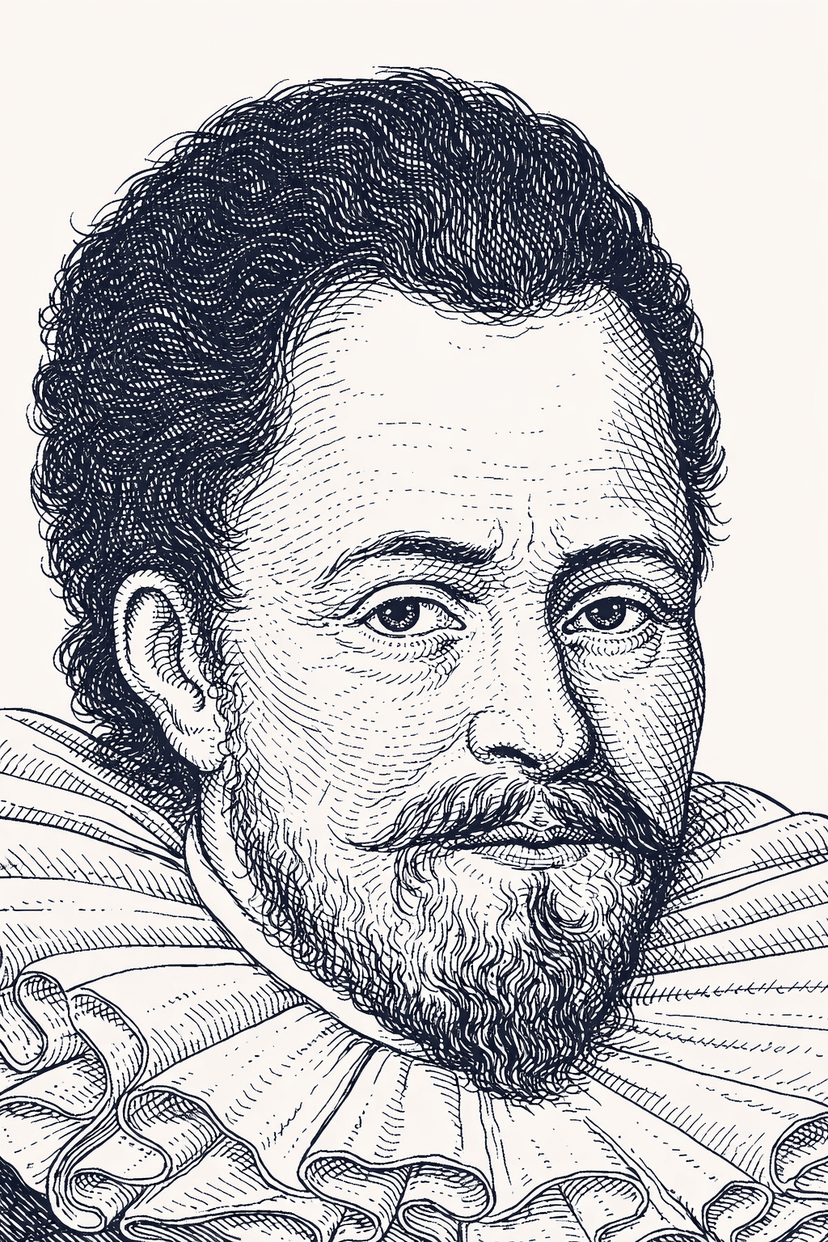
The name refers to Simon Stevin, one of the most important scientists of the Low Countries. He was born in Bruges, in Flanders, and made his name in the Dutch Republic, in Leiden and The Hague. His work was about making knowledge usable. In De Thiende of 1585 he explained how to calculate with decimal fractions in everyday work. He did not write it for mathematicians but for astronomers, surveyors, cloth measurers, wine gaugers, mint masters and merchants.
“Wonder en is gheen wonder.”
Simon Stevin, 1586
That idea fits exactly what we want to achieve with Stevin. Just as Simon Stevin made science accessible for practice, we make data, systems and information usable for everyday business decisions. Not by replacing everything, but by connecting existing knowledge more intelligently.
Stevin watches your marketing and remembers what happened.
It brings together what sits apart.
It notices what is missing.
It proposes the next step.
Your marketing sits in systems that live side by side: ad accounts, analytics, your shop, your enquiries. The information is usually there. Nobody sees it in time. That is where wasted budget and missed enquiries begin.
Stevin adds a layer over the systems you already use. We replace nothing: we read what is already there. The platform gets two things, your own numbers and what is happening outside your company, and flags a next step on that basis. Proposals, not decisions.
You stay in control
Stevin sends nothing out without a person having seen it. No email, no message, no change at a client. Collecting, summarising and flagging it does on its own, because nothing breaks there. Every recommendation states which numbers it rests on, and what the platform does is recorded.
We started in marketing because we did the work ourselves for twenty years. That is also why we dared to build the AI around it: you have to know how the work works to see when a model is wrong. And for that same reason we are careful about other fields. Information sitting scattered is true everywhere, but what that information means and what a mistake costs differs per trade. We only learn that once we are properly in it.
An example
Every night Stevin collects what is happening outside your company. School holidays in the Netherlands and Belgium, and in Germany per federal state, all sixteen. The weather measured against the ten-year average for that day, per country, with rainfall and hours of sun.
If it turns unusually warm in three weeks in the area where you advertise, that is not a piece of trivia. It is a reason to bring a campaign forward, or to hold it back. You get it as a signal, with the numbers underneath. What you do with it is your call.
Simon Stevin made visible how forces work together.
With Stevin.AI we make visible how marketing, data and follow-up work together. So you understand what is happening, and what you are basing your decisions on.
The wreath of spheres, 1586. A closed string of equally heavy spheres hangs over two slopes, evenly spaced. The long, shallow slope carries twice as many. Even so it does not pull harder, because the force along the slope is smaller per sphere. The part hanging underneath pulls equally to both sides and cancels out. If the string started turning on its own it would turn forever, which cannot be.
Simon Stevin in the Republic
From Bruges to The Hague
Stevin was born in Bruges in 1548, then part of the Habsburg Netherlands. In 1581 he moved north to Leiden. There, in 1583, he enrolled at the university William of Orange had founded eight years earlier, and met William's son Maurice. He later became tutor and adviser to Maurice, who had become stadtholder after his father's murder. At Maurice's request Stevin set up a course for engineers in Leiden in 1600, and from 1604 he was quartermaster of the States Army. He died in 1620, most probably in The Hague.
De Thiende (The Tenth), 1585
Stevin showed how to calculate with tenths, hundredths and thousandths, for merchants, surveyors and wine gaugers. He did not use a decimal point yet: after each digit he put a number in a small circle to mark its place.
The hydrostatic paradox, 1586
How hard water presses on the bottom depends only on how high it stands. Not on the shape of the vessel, and not on how much water is in it. Stevin showed this long before Pascal, who usually gets the credit.
Fortification, 1594
In De Sterctenbouwing Stevin explained, in Dutch, how to build a fortress: a regular hexagon with a bastion on every corner, laid out so that every wall can be defended from another.
Haven finding, 1599
At sea you could measure your latitude, but not your longitude. Stevin combined latitude with how far the compass deviated from north. Together they pointed to one place, so ships could find a harbour or each other.
The sailing chariot, around 1600
A wagon on four wheels with two sails. With Prince Maurice at the helm, Stevin and a company of guests rode it along the beach, from Scheveningen to Petten in about two hours. Faster than a horse.
Frequently asked questions
Who was Simon Stevin?
Simon Stevin (1548 to 1620) was a Flemish-Dutch mathematician, physicist and engineer, born in Bruges. He was known for making knowledge practical: he made decimal arithmetic and double-entry bookkeeping usable in everyday work. From 1581 he lived and worked in the northern Netherlands, in Leiden and The Hague, among other things as tutor and adviser to Prince Maurice.
Why is the platform named Stevin?
Just as Simon Stevin made science accessible for practice, the Stevin platform makes data, systems and information usable for everyday business decisions. Not by replacing everything, but by connecting existing knowledge more intelligently.
Where does Stevin come from?
The first idea was born in Belgium, at the founder’s own agency, with clients where three agencies in a row had worked on the measurement. The platform was further developed from Breda into the layer that now watches the marketing of clients.
Stevin connects data, context and action.
From ad to enquiry. From measurement to decision. From signal to execution.
Knowledge that works.
Start the diagnosisSimon Stevin, 1548 to 1620.