
For FMCG brands

Seven retailer portals. Seven definitions of good.

Each portal with its own ROAS and its own window. At the end of the quarter they do not add up, and nobody can say whether the brand campaign did anything at the shelf. We fix one definition and measure what can be measured.

Fifteen minutes of work on our side, no commitment. You see straight away which category questions your brand is missing from, and which retailer gives the answer there.

Stevin Intelligence Feed
Live
1/3

Measured on 4 September

Ask an AI which crackers are good. Your brand is not in the answer.

Seven buying questions from a Dutch supermarket category, put to an AI with live search. The way a light buyer asks: which brands make wholegrain biscuits, who sells crackers without added sugar. No brand name in the question.

0 of 7

times the brand site was a source

1 of 5

open category questions named the brand

ah.nl, jumbo.com

plus.nl and hoogvliet.com gave the answers

On a question about wholegrain biscuits it cited a webshop in New Zealand, and one in Brazil. Not the brand that makes those biscuits in the Netherlands. The retailer standing between you and the shopper at the shelf now stands between you and the answer. And here you cannot buy your way in.

Every quarterly report that adds up seven windows defends a budget with an empty number.

Seven portals, seven attribution windows. Add them up and you get something that looks like a ROAS but refers to nothing. And because the next agency brings its own definition, the discussion starts over every year.

Request the free scan

The scan shows in fifteen minutes where your brand stands on the light buyer's questions. Then you decide.

Two things we do not do.

We do not connect those portals

No integration with Ahold Delhaize, bol, Picnic, Amazon, Lidl or Carrefour, and we will not pretend. Anyone promising to bring those seven behind one login is selling you something nobody has solved well.

We are not a data vendor

No panel of our own, no licence for sale. We read what you already have. If your provider wants a signed agreement before a third party looks in, as NielsenIQ and Circana do, you hear that from us before you sign.

What you do get.

One definition, and it stays

What a conversion is, what belongs in the count and why. Recorded in your brand's name, not the agency's. The next agency inherits it instead of writing its own version.

Search demand as an early signal

Whether your brand search volume and your category are moving, and how they relate. You see that within days, not in the next quarterly report, and it runs ahead of the shelf.

What you already pay for goes in

NielsenIQ, Circana, YouGov, GWI, your brand tracker, your listening tool, your exports from the portals. If there is an API, we connect it. If there is an export, we read it. It ends next to your media data, with a definition underneath.

What that looks like

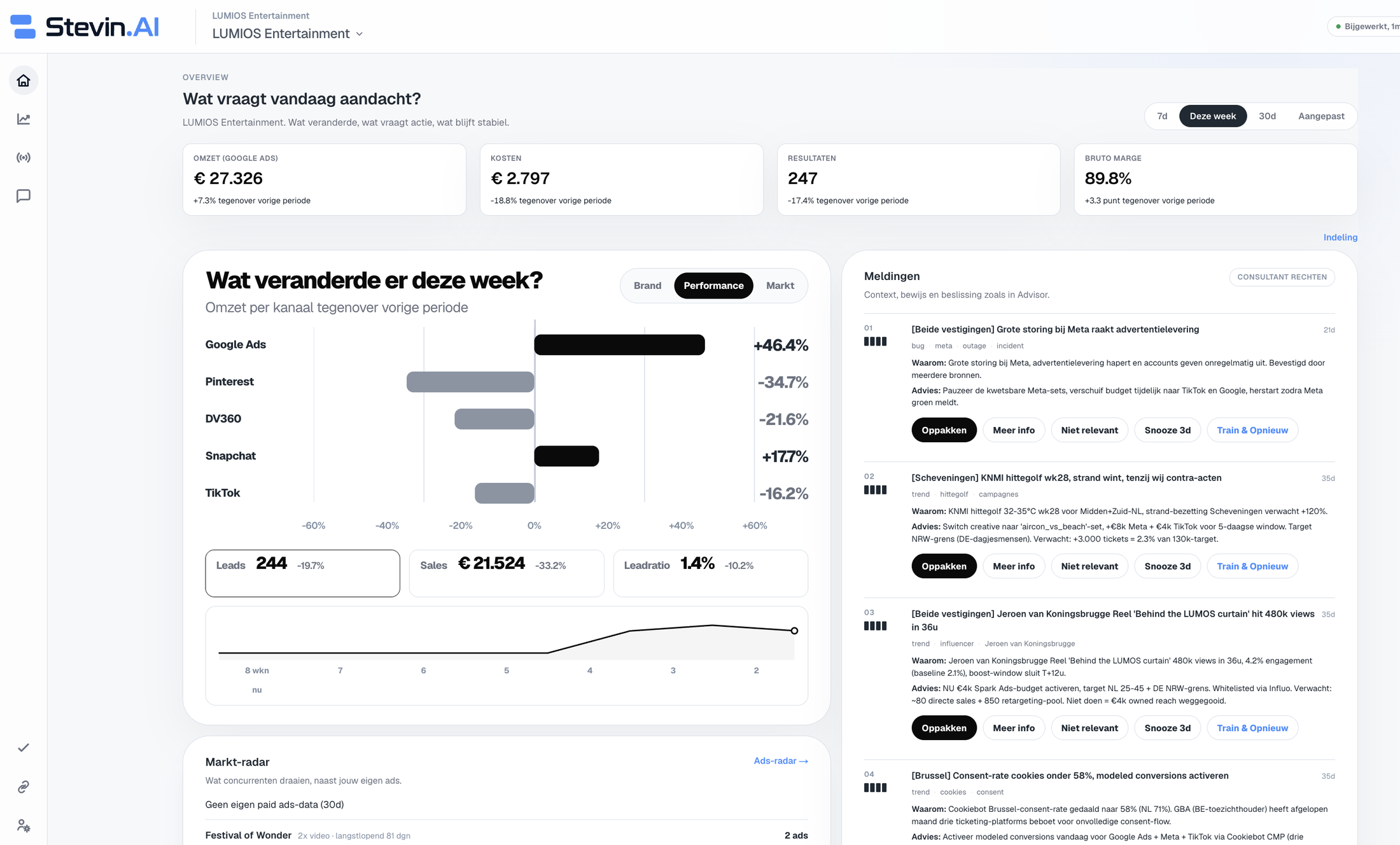
What is going wrong, what is working, and why. On one screen.

Not a report after the fact. Stevin watches what comes in today and what your brand is worth a year from now. Those are two different things, and they rarely sit in the same overview.

The Stevin Desk: alerts with the reason and the advice, numbers per channel and the market radar
06

[Category] Your category is picking up, your brand is not moving with it

search demandcategorycompetition

Why: Category search volume has been rising for three weeks while your brand search volume stays flat. In the same period two competitors started advertising on category terms in the public Google ad register.

Advice: Get your brand onto those category terms before the peak passes, and record what you did and why, so the next peak has something to compare against.

Pick upMore infoNot relevant

From the Stevin Desk. LUMIOS is our demo environment, not client data.

And everything that was tried is still there.

Every campaign, every decision, every result, and what the competition was doing at the time. Including the work that only pays off months later, which is the first thing to drop out of sight. Whoever starts here tomorrow reads up, instead of you explaining it all over again.

A single client memory, the way it sits in the Desk.Drag the nodes around.

The canon of your trade sits in the system.

Under every piece of advice sits a knowledge layer of 105 principles from published research. For FMCG those come from Ehrenberg-Bass and the IPA Databank, exactly the corner your category has steered by for decades. Three of them, with their limits.

Reach the whole category buyer.

Even large brands draw half their buyers from people who buy once or twice a year. Buyer classifications based on past behaviour are unstable.

Ehrenberg-Bass

Does not mean targeting is never useful. With a small, identifiable segment it can be.

Brand building and activation belong together, around 60/40.

Isolated short term campaigns do not add up to long term growth.

IPA Databank, Binet and Field

Does not mean 60/40 is a law. It is a calibration point that shifts with category, growth stage, budget and purchase frequency.

Evaluate brand work over at least six to twelve months.

Short measurement windows systematically favour activation and price. Brand effects are spread thin across many occasional buyers and invisible in weekly numbers.

IPA Databank

Does not mean brand work is unmeasurable. It needs different metrics and a different horizon, fixed in advance.

Why we know this.

Built by someone who spent twenty years on the other side of the invoice, a good part of it in FMCG. Media plans for brands in dairy, fruit and vegetables, drinks, snacks, personal care and pet care.

The strategy was usually fine: a model, an annual calendar, a split between brand and activation. What was missing was a measurement plan that answered whether it had worked. After dozens of brands, nobody could say with certainty whether a brand campaign had sold one extra pack. That is why this exists.

What brand teams ask us first.

Our media agency already does the reporting. What does this add?

A definition that does not belong to the agency, and a measurement that continues when the agency changes. We change nothing in your accounts and do not replace your agency. We make sure everyone's numbers refer to the same thing.

Are we even allowed to share our panel data with you?

That depends on your provider, and we find out before you sign anything. NielsenIQ requires a signed agreement for third-party access, Circana allows no sublicensing, Brandwatch does allow sharing the API key. We say it beforehand, not afterwards.

What does it cost?

The scan is free. After that you choose: monitoring only from 399 a month, or the full diagnosis on your own data. You keep the report, even if you do nothing further with us.

Start with the scan.

Fifteen minutes. No access to your accounts needed. You see which category questions your brand is missing from, and which retailer gives the answer there.

Fifteen minutes of work on our side, no commitment. You see straight away which category questions your brand is missing from, and which retailer gives the answer there.