
For venues and concert halls

Your ticketing system knows who went dormant. Your campaign does not.

Hundreds of shows a season, each with its own campaign, and a system full of labels nobody steers on. We put sales per title next to demand per title, and make sure next season starts with what this season taught.

Fifteen minutes of work on our side, no commitment. You see straight away which questions from someone looking for a night out your venue is missing from.

Measured in the night of 4 September

We measured a city theatre. On the specific questions it won. On the broad question about its own trade it did not.

Seven questions put to an AI with live search, about a city theatre in the south of the Netherlands. Which theatre is good for families, where can you take workshops, what does a night out cost, which venue suits a school trip. And the broad one: which theatre in this city for cabaret, musicals and plays.

4 of 7

times its own site was a source: families, workshops, prices, schools

0 of 2

times on the broad question about cabaret, musicals and plays, its own trade

explorebreda

and the city tourism site answered what makes the theatre unique

That is the pattern at a well programmed venue: on the specific question you are there, on the question of someone simply looking for a night out you are not, and who you are is told by the tourism site of your city in your place. Exactly the visitor you do not know yet, and exactly the story you would want to tell yourself.

Every title gets a new campaign, and every campaign starts from zero.

The show that is not selling gets extra budget in the last week, the show that sells itself gets the same plan as always. What worked for the same title last season, nobody remembers. So every season you pay for the same lesson again.

Request the free scan

The scan shows in fifteen minutes which questions you are missing. Then you decide.

Two things we do not do.

We do not connect your ticketing system

No integration with your ticketing platform or CRM. We read your export: sales per title per day, and the labels your system already keeps. That is enough to steer on, and more honest than pretending we look into your till.

We do not programme with you

Which show you book is your trade. We do not say what belongs on stage, we say what demand per title is doing and where the budget should sit now.

What you do get.

Per title: sales next to demand

How much is sold, how much is searched, and how the two relate, per show. A title with high demand and low sales is a different problem from a title nobody searches for, and the plan should know that.

The labels you already have, in the campaign

New, frequent, dormant, lapsed: your system knows them, your ads do not. We make sure the dormant customer sees a different offer than the regular, and measure whether they come back.

A memory from season to season

What this title did last year, what it cost, what you learned. Including what did not work. So the season launch is not a new experiment every year.

What that looks like

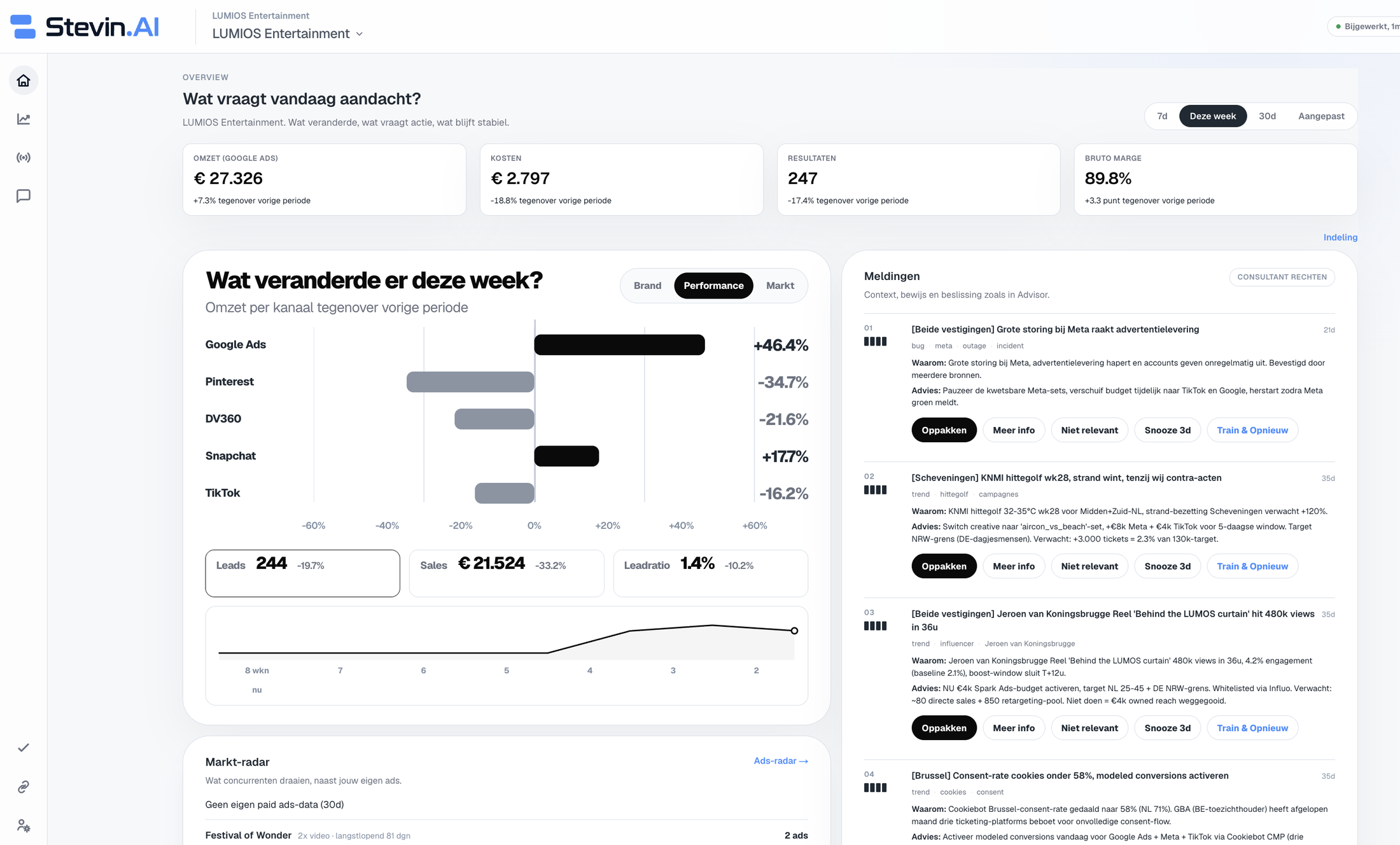
What is going wrong, what is working, and why. On one screen.

Not a report after the fact. Stevin watches what comes in today and what your brand is worth a year from now. Those are two different things, and they rarely sit in the same overview.

The Stevin Desk: alerts with the reason and the advice, numbers per channel and the market radar
02

[The Hague] Heatwave week 28, the beach wins unless we counter

trendheatwavecampaigns

Why: Heatwave of 32-35°C forecast for week 28, beach occupancy expected up 120%. The Brussels venue is unaffected.

Advice: Switch creative to the indoor set and shift budget for a five-day window, only for the venue it hits.

Pick upMore infoNot relevant

From the Stevin Desk. LUMIOS is our demo environment, not client data.

And everything that was tried is still there.

Every campaign, every decision, every result, and what the competition was doing at the time. Including the work that only pays off months later, which is the first thing to drop out of sight. Whoever starts here tomorrow reads up, instead of you explaining it all over again.

A single client memory, the way it sits in the Desk.Drag the nodes around.

Why the advice holds.

Under every piece of advice sits a knowledge layer of 105 principles from published research. Three of them are about exactly this trade, as they sit in the system, with their limits.

Growth comes primarily from more new visitors, not from making existing visitors more loyal.

Brands of similar size have almost identical loyalty. The ones that grow reach more people who have not come yet. For a venue: into the city, not only into the newsletter.

Ehrenberg-Bass

Does not mean your regulars do not matter. They are your first week at every launch, just not your growth.

Be critical of loyalty programmes as a growth strategy.

People who sign up are customers you already had. A friends scheme or subscription retains, but rarely brings in someone who would not have come otherwise.

Ehrenberg-Bass

Does not mean you should scrap them. They just belong in the retention plan, not the growth plan.

Judge results only after a full conversion cycle.

Costs are complete immediately, tickets trickle in. Anyone settling a campaign after a week is judging the audience that decides the week before the show.

Practice principle from the knowledge layer

Does not mean you wait until the night itself. Search demand and the cost side you see straight away.

Why we know this.

Built by someone who spent twenty years on the other side of the invoice, as the founder of an agency, working out the annual plan for a concert hall. The picture from that conversation: a ticketing system that already gave every visitor a label, from new to lapsed, and nobody who could draw the route from first ticket to regular.

The numbers already said it: the young audience was the largest share of visits, conversion sat with the over-65s, and the best performing campaign was the retargeting of people who had already been. Everything pointed at the visitor you already know. So this starts with demand per title, with the labels you already have, and with a memory that outlives the season.

What venues ask us first.

We have an agency for the campaigns per show. Can this run alongside?

Yes. We take over no campaigns and change nothing in accounts. We put sales and demand per title side by side and record what worked, so your agency does not start next season from zero. Your agency keeps its work, you keep the memory.

Our ticketing system already has labels. What does this add?

The step from label to campaign. Your system knows who went dormant; your ads show them the same thing as the regular. We make sure the difference ends up in the campaign, and that you measure whether the dormant customer comes back.

What does it cost?

The scan is free. After that you choose: monitoring only from 399 a month, or the full diagnosis on your own numbers. You keep the report, even if you do nothing further with us.

Start with the scan.

Fifteen minutes. No access to your accounts needed. You see which night-out questions your venue is missing from, and who is there instead.

Fifteen minutes of work on our side, no commitment. You see straight away which questions from someone looking for a night out your venue is missing from.